Showing posts with label Wine Making. Show all posts

Monday, July 28, 2014

Dandelion Wine

I believe it was the middle of May when the idea came to mind to try making dandelion wine.  I had a multitude of dandelions dotting my yard and a long weekend in which to get started, so start I did.  I followed a recipe from Jack Keller's Wine making website which is a great website to visit if you are learning how to make wine.  The recipe calls for about 2 quarts of dandelion flower petals.  Some recipes use whole flowers, but this one just called for the petals which tends to make a less bitter wine because the green parts of the plant are what make the bitter flavor.  So I spent a good half hour plucking dandelions from their stalks.  I think I ended up with a half gallon of flowers in the end.
 
Once the flowers were all washed I then proceeding to remove flower petals from the base of the flowers one pinch at a time.  It was a messy and tedious job and it took me about and hour and a half and left me with yellow sticky fingers when I was done.
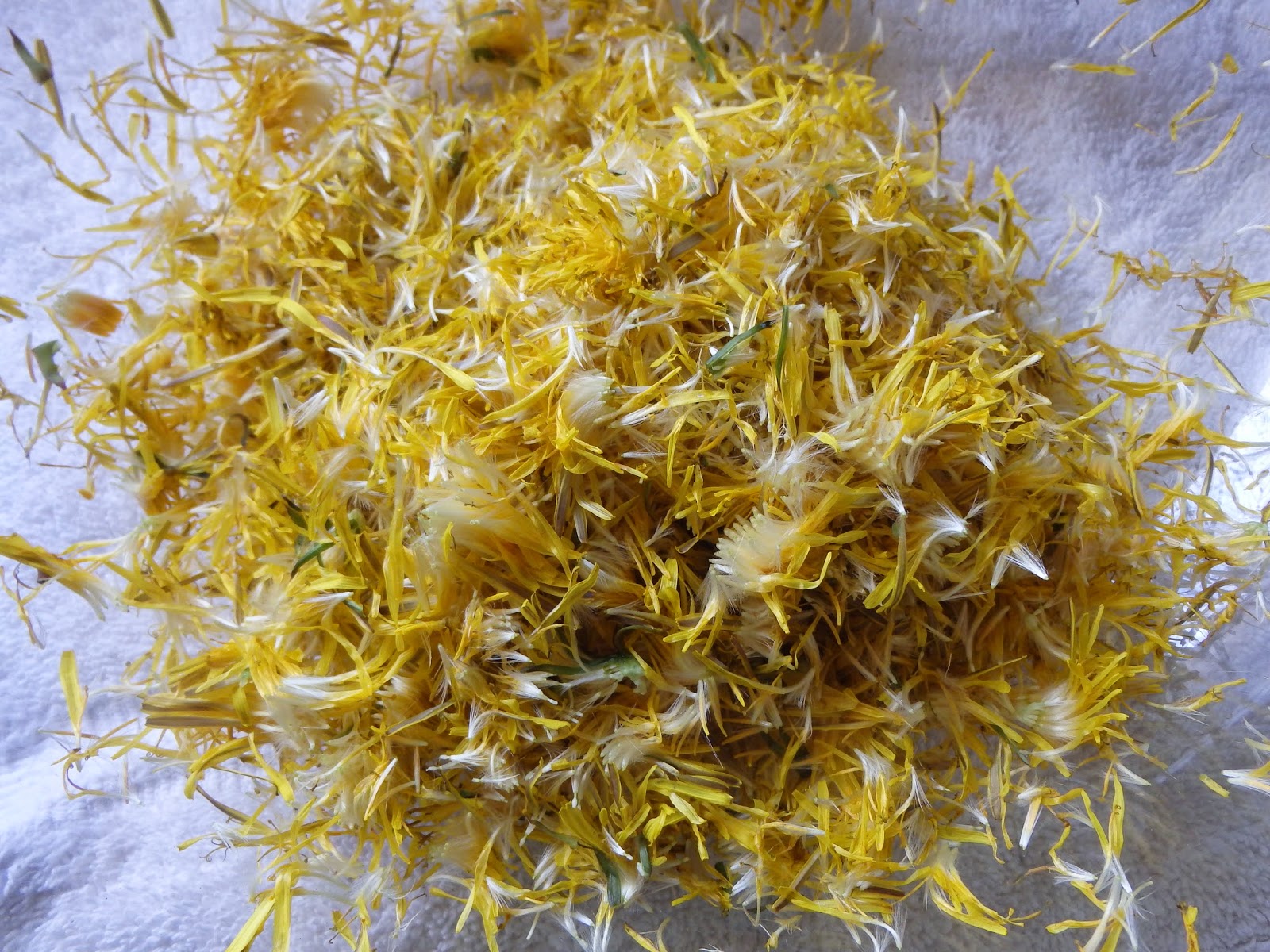
 
While I was preparing my petals I had set a gallon of water on the stove to boil.  Once it had reached a nice boil I poured it over the flower petals and then covered the mixture with a towel. 
 
 
After two days of steeping I strained the liquid and once again brought it to a boil.  I added six cups of sugar to the liquid which at this point was a lovely golden amber color.  While it was boiling I carefully peeled the rind from four ripe oranges doing my best to not have any of the pithy white part in my shavings.  Once peeled I then juiced the oranges and added the juice and the rind shavings and let it boil for ten minutes.  Once the ten minutes was up I removed the pot from heat and waited until the temperature came down to about 105 degrees.  At that point I added a packet of champagne yeast and one teaspoon of yeast nutrient.  Once everything was well mixed and had started to bubble I transferred all the liquid into a one gallon glass jug and fitted it with an airlock.
 
 
I set the happily bubbling jug in a closed box in the corner where it could ferment in peace in the dark.  After about a month I had noticed that it wasn't bubbling anymore so I racked the wine into a clean jug leaving behind all the dead yeast that had built up a thick sediment in the bottom.  I refitted the airlock and then left it in the jug for another month, just to be sure that it was finished fermenting.
 
Once I was satisfied that there was no more fermenting taking place I cleaned up my wine bottles and rinsed them with boiling water just to make sure they were as sterile as possible.  Then one by one I filled them and corked them.
 
Here the finished product sits glowing in the sun.  The recipe states that the flavor improves with time and should be aged for at least 6 months before drinking.  However I had one bottle that I could only fill half way, so into the fridge it went for sampling of course!  Considering that this wine has four more months to "improve" I think it may very well be phenomenal by that time.  As of right now it tastes like a flower mixed with honey with a touch of citrus.  It is a little on the sweet side though at first sniff you might think it was a dry wine.  It is also a touch on the strong side if my hydrometer readings are correct - somewhere in the realm of 14%.  Overall I'd have to say it's pretty darn good for a first attempt.
 

Monday, February 18, 2013

Wine making

Last year I bought a wine making kit for my boyfriend for Christmas.  Having never made wine before we weren't quite sure what to expect with our first attempt. We decided to start with something simple so if we messed it up, we wouldn't be out a lot of money or effort, so Welch's grape juice wine is what we made.  I can't say that I remember the exact ingredients that we used but I think it went along the lines of grape juice (enough for 6 gallons), water, sugar, and wine yeast.  We decided not to use the Camden tablets or any other additives that web sites suggested because we just wanted to see if the basic process worked.

It all starts with mixing the grape juice, water, sugar and yeast in the fermentation bucket.  Once that is done it just needs to sit for about a week and bubble away.

The next step is to transfer the wine from the bucket into a glass carboy.  Thankfully the kit comes with a pump to make the job much easier and allows the sediment (aka yeast bodies and stuff) to remain at the bottom.  Once the wine was transferred we just corked it with the bubbler thing that allows gas to escape and put it in a dark, cool room until the bubbling stopped - which took about a month, maybe two.


Once we were sure that the fermentation had stopped it was time to transfer the wine into bottles.  We had saved a bunch of bottles over the months for just such an occasion.  First we had to sterilize the bottles by soaking them in a bleach solution and then rinsed them with hot water.  We set the clean bottles in the sun to dry.


Once the bottles were dry we filled them with our wine and corked them with a corker.  Without a corker I think it would be darn near impossible to get those things to fit inside the bottle! 


The finished product tasted a whole lot like wine, though maybe not as strong as some of the stuff you can find at the store.  For a red wine it was not as dry as they normally seem to be and was a bit sweeter than what you would expect.  This one batch of wine filled about 30 wine bottles which sounds like a lot, but once you start giving them away, it really isn't that much. 


A few weeks later we discovered that our fermentation may not have been finished - our wine became fizzy like champagne.  Either that or we used the wrong kind of yeast.  Thankfully we gave away and drank it fast enough that no bottles exploded on us (or anyone else).  Guess we have to do a little more research on how to tell when your wine is finished.